Figure Eight Knot

Figure Eight Stopper Knot: An Essential Sailing Knot Every Sailor Should KnowAt Lake St. Clair Sailing School, we emphasize practical seamanship skills that make sailing safer, smoother, and more enjoyable. One of the most fundamental knots every sailor should master is the Figure Eight Stopper Knot.What Is a Figure Eight Stopper Knot?The figure eight stopper knot is tied at the end of a line to prevent it from slipping through a block, cleat, or fitting. Its distinct “8” shape creates a reliable stopper that is easy to recognize, strong under load, and simple to untie even after being under tension.Why Sailors Use the Figure Eight Stopper KnotThis knot is widely used in sailing…

Comments Off on Figure Eight Knot

Points of Sail

Points of Sail The Points of Sail are a convenient way of describing boat angle compared to the direction of the wind. Learning the Points of Sail will help you trim your sails at different boat angles to the wind and make you a better sailor. When the skipper says, “head up into a Close Haul”, as a crew member this will tell you that you need to tension the sheets (pull in the sails). Alternatively, if the skipper says, “bear away onto a Broad Reach”, you will know to ease the sheets (let out the sails).

Comments Off on Points of Sail

Stern Light

Stern Light Rule 21(c) Stern Light: The stern light is a white light placed as near as is practicable at the stern. The light shines in an arc of 135 degrees.

Comments Off on Stern Light

Sideligths

Sidelights Rule 21(b) Sidelights: Sidelights are red (port side) and green (starboard side) lights than shine in an arc of 112.5 degrees from straight ahead to a point 22.5 degrees abaft the beam.

Comments Off on Sideligths

Masthead Light

Masthead Light Rule 21(a) Masthead Light: The ‘masthead light’ is a white light placed over the fore and aft centerline of the vessel showing with an arc of 225 degrees.

Comments Off on Masthead Light

Sailing Terms

Glossary of Sailing Terms AAbaft: A location on the boat but further to the rear of the boat. “The tiller is abaft the mast.Abeam: The beam is the widest part of the boat. When another boat is abeam, it is at a right angle off the beam to either the starboard or port side of the boat you are on.Aft: When on a boat you refer to the stern part of the boat as being aft or to the rear of the boat.Ahead: A term used to describe the area in front of the boat you are on. “Look ahead.Aids to Navigation: This includes all external systems like channel markers, preferred route buoys, danger and safe water buoys,…

Comments Off on Sailing Terms

Towing An Inconspicuous, Partly Submerged Object

Towing an inconspicuous, partly submerged object An inconspicuous, partly submerged vessel or object, or combination of such vessels or objects being towed, shall exhibit: if it is less than 25 metres in breadth, one all-round white light at or near the forward end and one at or near the after end if it is 25 metres or more in breadth, two additional all-round white lights at or near the extremities of its breadth; if it exceeds 100 metres in length, additional all-round white lights between these lights so that the distance between the lights shall not exceed 100 metres; a diamond shape at or near the aftermost extremity of the last vessel or…

Comments Off on Towing An Inconspicuous, Partly Submerged Object

Towing

Towing A power-driven vessel when towing shall exhibit: two masthead lights in a vertical line. When the length of the tow, measuring from the stern of the towing vessel to the after end of the tow exceeds 200 metres, three such lights in a vertical line;sidelights;a sternlight;a towing light in a vertical line above the sternlight;when the length of the tow exceeds 200 metres, a diamond shape where it can best be seen. Tugboat longer than 50 m - tow longer than 200 mAbeam, port sideAhead, Day sign(diamond shapes)AheadAsternTugboat shorter than 50 m - tow longer than 200 mAbeam, port sideAhead, Day sign(diamond shapes)AheadAsternTugboat longer than 50 m - tow shorter than 200…
Comments Off on Towing

Aground Vessels: How to Recognize the Signals on Lake St. Clair

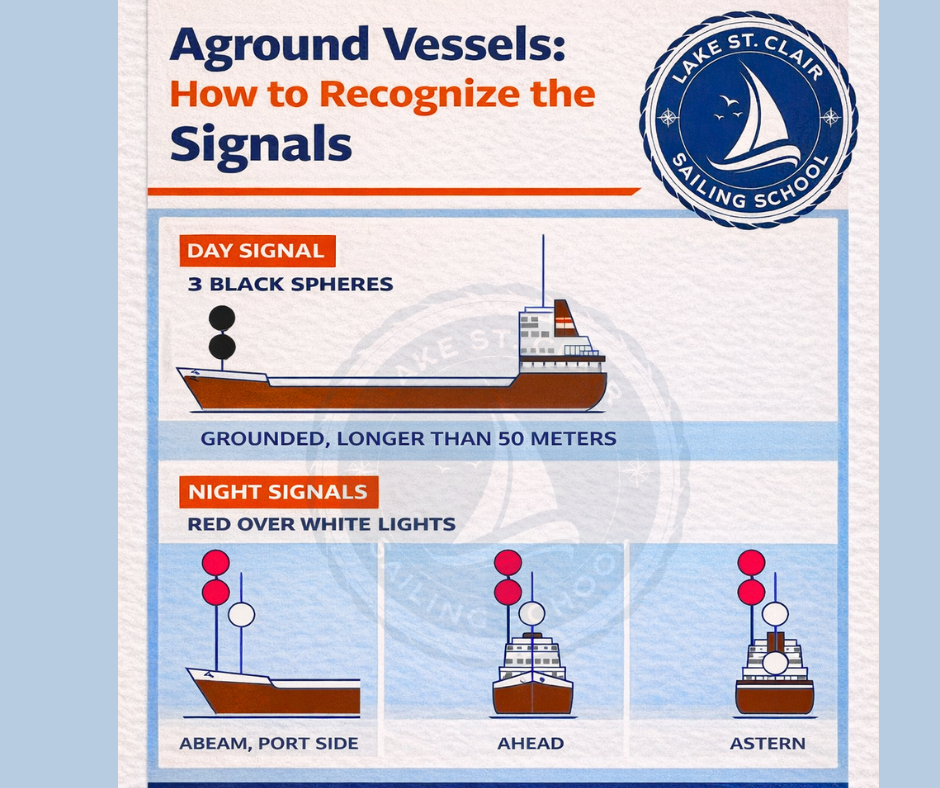
Aground Vessels: How to Recognize the Signals on Lake St. Clair When sailing on Lake St. Clair, understanding navigation signals is essential for safety and confident seamanship. One important situation every sailor should recognize is an aground vessel. The attached image illustrates the correct day shapes and night lights displayed by large vessels that are aground, and knowing what these signals mean can help you avoid danger on the water. What Does “Aground” Mean? A vessel is considered aground when it is stuck on the bottom and unable to maneuver as intended. This may happen in shallow areas, channels, or near shoals. On Lake St. Clair, where water depths can change quickly, recognizing…

Comments Off on Aground Vessels: How to Recognize the Signals on Lake St. Clair
aground
aground

End of content

No more pages to load