Sheet Bend Knot

Sheet Bend https://www.youtube.com/embed/aK-1LJNYTIs The sheet bend knot is used to tie two lines of equal or unequal thickness together. The sheet bend knot can be tied anywhere into another line and therefore it can be used to lengthen or shorten the overall length of a line. Always make your bend (U shaped loop) in the thicker of the two lines.

Comments Off on Sheet Bend Knot

Lateral Aids to Navigation

Lateral Marks These show well-established channels and indicate port (left) and starboard (right) sides of the channels. Port marks are a red can shape. At night, a red flashing light may be shown. Starboard marks are a green conical shape. At night a green flashing light maybe shown. Lateral Aids to Navigation generally indicate which side of an aid to navigation a vessel should pass when channels are entered from seaward. In the absence of a route leading from seaward, the conventional direction of buoyage generally follows a clockwise direction around landmasses

Comments Off on Lateral Aids to Navigation

Clove Hitch

Clove Hitch Knot: A Fast but Temporary Sailing Knot At Lake St. Clair Sailing School, we teach sailors not only how to tie knots, but when to use them correctly. The clove hitch is a common and useful knot in sailing, but it should always be used with an understanding of its limitations. What Is a Clove Hitch? The clove hitch is a quick and simple knot used to temporarily secure a line to a spar, post, or railing. It is easy to tie and adjust, making it helpful for short-term tasks onboard a sailboat. When to Use a Clove Hitch The clove hitch works best when: You need a fast, temporary tie-off…

Comments Off on Clove Hitch

Round Turn & Two Half Hitches

Round Turn & Two Half Hitches: A Reliable Knot for Docking and Securing Lines At Lake St. Clair Sailing School, we focus on teaching practical sailing knots that every sailor will use regularly on the water. One of the most dependable and commonly used knots is the Round Turn & Two Half Hitches. What Is the Round Turn & Two Half Hitches? The round turn & two half hitches is a strong and versatile knot used to secure a line to a fixed object. It begins with several wraps (the round turn) around a post, ring, or rail, followed by two half hitches that lock the line in place. The round turn reduces…

Comments Off on Round Turn & Two Half Hitches

Anchor Light

All-round Light Rule 21(e) All-round Light: The all-round light (such as the white anchor light) shines in an arc of 360 degrees.

Comments Off on Anchor Light

Bowline Knot

The Bowline Knot: A Must-Know Knot for Every Sailor At Lake St. Clair Sailing School, we teach knots that every sailor will rely on throughout their sailing journey. One of the most important and commonly used knots in sailing is the bowline knot. What Is the Bowline Knot? The bowline knot creates a fixed loop at the end of a rope that is exceptionally strong yet easy to untie, even after being under heavy load. Because the loop does not slip or tighten, the bowline is trusted by sailors around the world for docking, mooring, and securing lines. Why the Bowline Knot Is So Popular in Sailing The bowline is a favorite among…
Comments Off on Bowline Knot

Types of Anchors

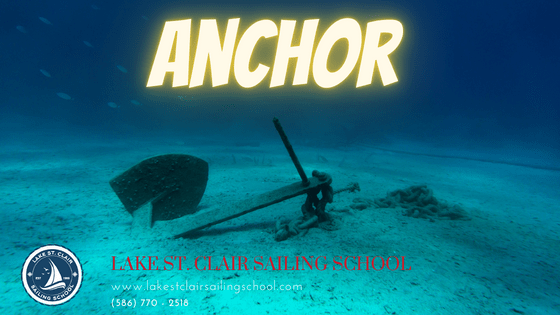
Anchor Types Kedge Anchors – Used for centuries they are the traditional anchor shape we are used to. Modern kedge style anchors are lighter and have been adapted for specialized use. Sharp bills and small flukes hold better in hard sand. Broader flukes and larger arms hold better in soft bottoms or rocks and coral. Kedge anchors are often used successfully in heavy vegetation. *Softer bottoms, hard sand, Rocks and Coral, Weeds Plow Anchors – When the plow anchor first lands, it is on its side but as it gets pulled the anchor rights itself and gradually plows into the bottom. It buries itself and holds well. Because this anchor type swivels horizontally on a hinged shaft,…

Comments Off on Types of Anchors

Required Safety Equipment

Life JacketsA properly fitting and serviceable jacket for every person on board. Fire ExtinguisherIt must be a Coast Guard-approved B1 model. ThrowableBoats over 16 feet must carry a throwable device. Signaling DeviceA bell, whistle, or horn to warn other boaters. Visual Distress SignalPhoto of a hand flare For boats under 16 feet, this is required only at night; for boats over 16 feet, this is required both day and night. Different rules apply on small bodies of water, but it’s always wise to carry them.

Comments Off on Required Safety Equipment
Required Safety Equipment

Light Recognition

Basic Collision Regulations Light Recognition All vessels over 7m long carry side lights and stern (overtaking) lights.Motor vessels carry a white masthead (steaming) light shining forward 225°.Motor vessels over 50 m long carry a second masthead (steaming) light aft and above the first masthead light.A motor vessel less than 7m long may carry a single all round white light.A sailing vessel less than 7m long should show side and stern lights if possible, or carry a torch to illuminate the sails when necessary

Comments Off on Light Recognition

End of content

No more pages to load