Understanding Variation and Deviation on Lake St. Clair

Navigation 101: Understanding Variation and Deviation on Lake St. Clair If you have ever taken the helm of a boat on Lake St. Clair, you know that safe navigation is about more than just keeping an eye out for freighter traffic or finding the channel markers into the shipping canal. It requires knowing exactly which way your vessel is pointing. While modern GPS plotters and smartphone apps make navigation look effortless, every seasoned captain knows that electronics can fail. The ultimate backup—and the foundation of true seamanship—is your boat’s magnetic steering compass. However, a magnetic compass almost never points to True North. Instead, it is constantly fighting against two distinct types of magnetic…
Comments Off on Understanding Variation and Deviation on Lake St. Clair

Mainsheet vs. Traveler: What Each One Actually Controls

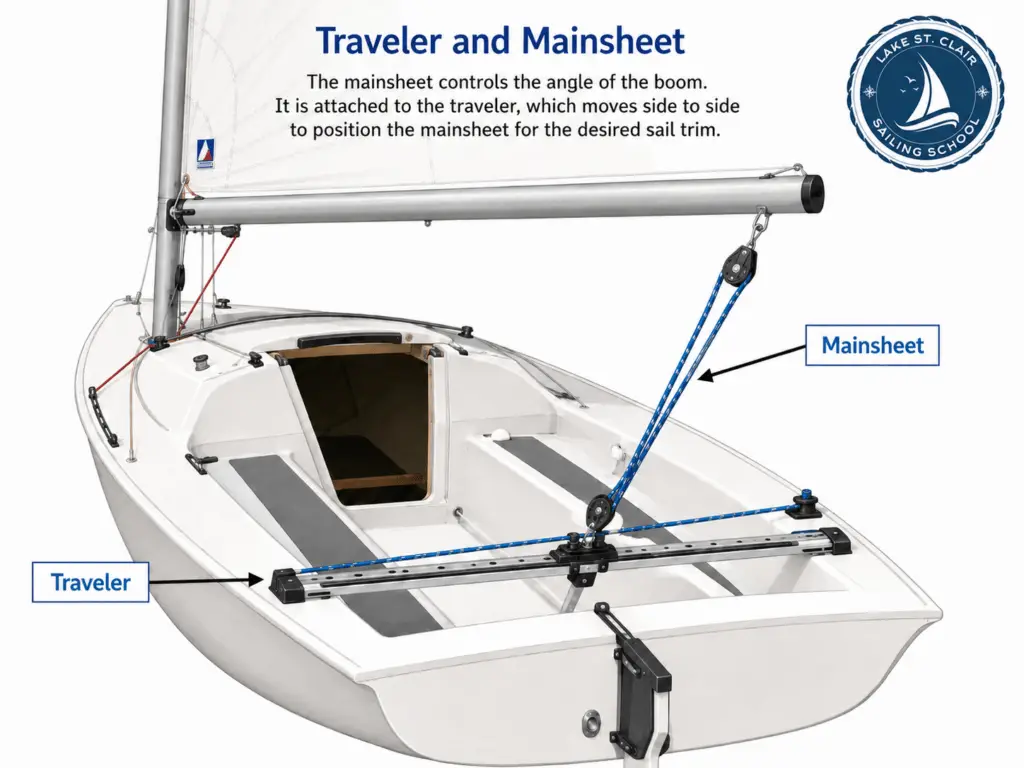
Mainsheet vs. Traveler: What Each One Actually Controls If you've spent any time around a sail trim conversation at the dock, you've probably heard two pieces of advice that sound like they contradict each other: "ease the mainsheet to depower" and "drop the traveler to depower." Both are right. They just do different jobs. This is one of the most commonly misunderstood relationships in sail trim, and it trips up new sailors and experienced ones alike. The short version: the mainsheet controls twist. The traveler controls angle of attack. Mix those two up and you'll spend a lot of time over-trimming, under-trimming, or fighting a heel angle you don't need to fight. Let's…

Comments Off on Mainsheet vs. Traveler: What Each One Actually Controls
Traveler vs Main sheet on a sailboat

Points of Sail Quiz

Points of Sail Quiz — Lake St. Clair Sailing School Lake St. Clair Sailing School Points of Sail Quiz 15 questions · Wind angle, sail trim, maneuvers & right of way Question 1 of 15 0 correct N S E W

Comments Off on Points of Sail Quiz

ASA 104: Bareboat Cruising Prep Quiz

html   Lake St. Clair Sailing School ASA 104 — Bareboat Cruising Score — Correct 0 Answered 0 / 100 Topic: All (100) Seamanship Systems Navigation Safety & Rules Weather & Tides Quiz Complete —% 0Correct 0Wrong 100Questions Retake Full Quiz Retry Wrong Only ↑

Comments Off on ASA 104: Bareboat Cruising Prep Quiz

Why is it Wind Blowing AgainstTide (or any current) Can Create Uncomfortable Seas

Why is it Wind Blowing against tide (or any current) can create uncomfortable seas. Here's the simple idea: imagine you're in a bathtub, splashing water toward one end. Now picture someone else pushing the water back the other way at the same time. The water doesn't just cancel out — it stacks up and gets really bumpy and choppy! That's exactly what happens on the water when wind blows against a current or tide. The current is like a giant, invisible river pushing water in one direction The wind pushes on the surface of the water in the opposite direction The waves get shorter, steeper, and much closer together — instead of gentle…

Comments Off on Why is it Wind Blowing AgainstTide (or any current) Can Create Uncomfortable Seas

Marine Diesel Engine Checks Every Sailor Should Know

Marine Diesel Engine Checks Every Sailor Should Know When most sailors think about seamanship, they focus on sail trim, navigation, weather forecasting, and docking skills. However, one of the most important systems on any cruising sailboat is often overlooked—the marine diesel engine. A reliable engine can help you safely leave and enter harbors, maneuver in tight marinas, avoid hazards, and provide an extra margin of safety when the wind disappears. Unfortunately, mechanical breakdowns remain one of the most common reasons for emergency assistance on the water. Regular engine inspections can prevent many of these problems before they occur. The WOBBLE Engine Check At Lake St. Clair Sailing School, we encourage sailors to perform…

Comments Off on Marine Diesel Engine Checks Every Sailor Should Know

Common Method: Compass Swing

Deviation is the error caused by the sailboat’s own magnetic fields affecting the compass. To calculate it, you compare your boat’s compass heading to a known accurate heading and measure the difference. Basic Formula Deviation=Magnetic Heading−Compass Heading\text{Deviation} = \text{Magnetic Heading} - \text{Compass Heading}Deviation=Magnetic Heading−Compass Heading If the compass reads lower than the magnetic heading → deviation is East. If the compass reads higher than the magnetic heading → deviation is West. Common Method: Compass Swing This is the standard method used on sailboats. Step 1: Choose Calm Conditions Minimal wind/current Flat water Electronics and metal objects in normal operating positions Step 2: Steer Known Headings You steer the boat on several headings: N NE E SE S…

Comments Off on Common Method: Compass Swing

Sailing by the Lee — Explained Simply

Sailing by the Lee — Explained Simply Sailing by the lee happens when a sailboat sails so deep downwind that the wind crosses the stern and starts pushing on the back side of the mainsail. Normally, sails are designed to work with wind flowing smoothly over the windward side. When sailing by the lee, the wind hits the sail from the opposite direction while the boom remains out on the same side. Think of it as sailing slightly past a normal dead-downwind course. The Difference Between a Run and By-the-Lee Sailing on a Run Boat points directly downwind. Wind comes straight from behind. The mainsail acts mostly like a parachute. The boom is…

Comments Off on Sailing by the Lee — Explained Simply

Mastering the Whisper: 4 Essential Tips for Sailing in Light Wind on Lake St. Clair

Mastering the Whisper: 4 Essential Tips for Sailing in Light Wind on Lake St. Clair Midsummer on Lake St. Clair brings gorgeous, sun-drenched days, but it also brings those notorious, glassy afternoons where the wind drops down to a mere 3 knots. For many sailors, a lack of wind means turning on the auxiliary engine. But for a true sailor, light air presents one of the most rewarding challenges on the water. Sailing in 3 knots of wind requires a delicate, ultra-light touch. Your main priorities shift from managing power to generating maximum lift, reducing onboard weight, and preserving every ounce of precious momentum. Whether you’re practicing for your ASA certification or just…

Comments Off on Mastering the Whisper: 4 Essential Tips for Sailing in Light Wind on Lake St. Clair
sailing in 4 knots
sailing in 4 knots

End of content

No more pages to load