Lake St. Clair Sailing School sailing events
Why is it Wind Blowing against tide (or any current) can create uncomfortable seas. Here's the simple idea: imagine you're in a bathtub, splashing water toward one end. Now picture someone else pushing the water back the other way at the same time. The water doesn't just cancel out — it stacks up and gets really bumpy and choppy! That's exactly what happens on the water when wind blows against a current or tide. The current is like a giant, invisible river pushing water in one direction The wind pushes on the surface of the water in the opposite direction The waves get shorter, steeper, and much closer together — instead of gentle…
Marine Diesel Engine Checks Every Sailor Should Know When most sailors think about seamanship, they focus on sail trim, navigation, weather forecasting, and docking skills. However, one of the most important systems on any cruising sailboat is often overlooked—the marine diesel engine. A reliable engine can help you safely leave and enter harbors, maneuver in tight marinas, avoid hazards, and provide an extra margin of safety when the wind disappears. Unfortunately, mechanical breakdowns remain one of the most common reasons for emergency assistance on the water. Regular engine inspections can prevent many of these problems before they occur. The WOBBLE Engine Check At Lake St. Clair Sailing School, we encourage sailors to perform…
Deviation is the error caused by the sailboat’s own magnetic fields affecting the compass. To calculate it, you compare your boat’s compass heading to a known accurate heading and measure the difference. Basic Formula Deviation=Magnetic Heading−Compass Heading\text{Deviation} = \text{Magnetic Heading} - \text{Compass Heading}Deviation=Magnetic Heading−Compass Heading If the compass reads lower than the magnetic heading → deviation is East. If the compass reads higher than the magnetic heading → deviation is West. Common Method: Compass Swing This is the standard method used on sailboats. Step 1: Choose Calm Conditions Minimal wind/current Flat water Electronics and metal objects in normal operating positions Step 2: Steer Known Headings You steer the boat on several headings: N NE E SE S…
Sailing by the Lee — Explained Simply Sailing by the lee happens when a sailboat sails so deep downwind that the wind crosses the stern and starts pushing on the back side of the mainsail. Normally, sails are designed to work with wind flowing smoothly over the windward side. When sailing by the lee, the wind hits the sail from the opposite direction while the boom remains out on the same side. Think of it as sailing slightly past a normal dead-downwind course. The Difference Between a Run and By-the-Lee Sailing on a Run Boat points directly downwind. Wind comes straight from behind. The mainsail acts mostly like a parachute. The boom is…
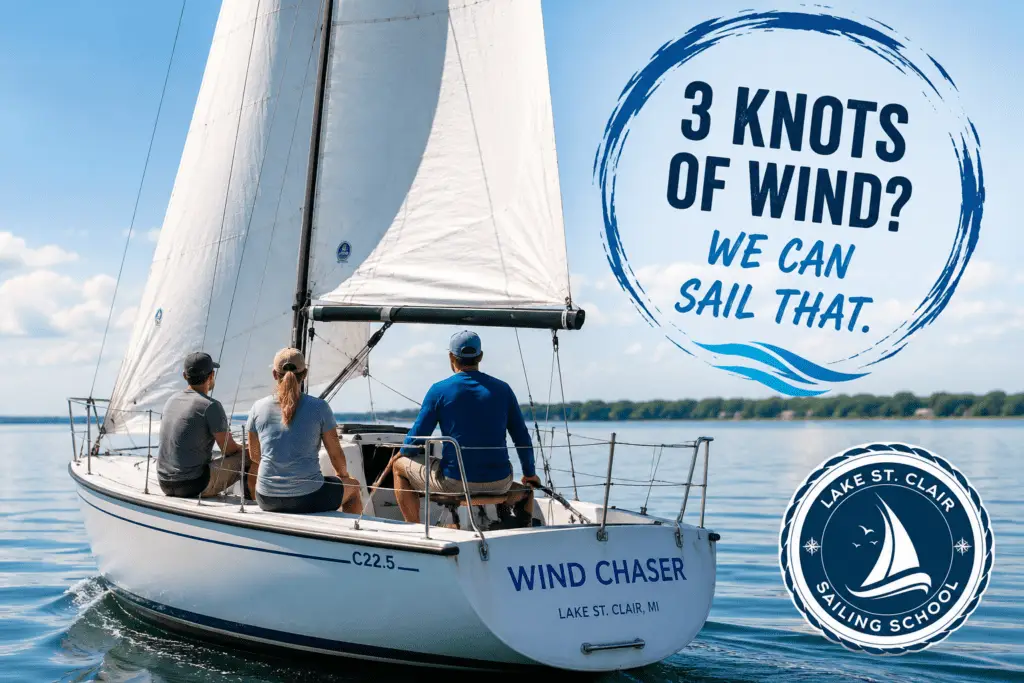
Mastering the Whisper: 4 Essential Tips for Sailing in Light Wind on Lake St. Clair Midsummer on Lake St. Clair brings gorgeous, sun-drenched days, but it also brings those notorious, glassy afternoons where the wind drops down to a mere 3 knots. For many sailors, a lack of wind means turning on the auxiliary engine. But for a true sailor, light air presents one of the most rewarding challenges on the water. Sailing in 3 knots of wind requires a delicate, ultra-light touch. Your main priorities shift from managing power to generating maximum lift, reducing onboard weight, and preserving every ounce of precious momentum. Whether you’re practicing for your ASA certification or just…
sailing in 4 knots
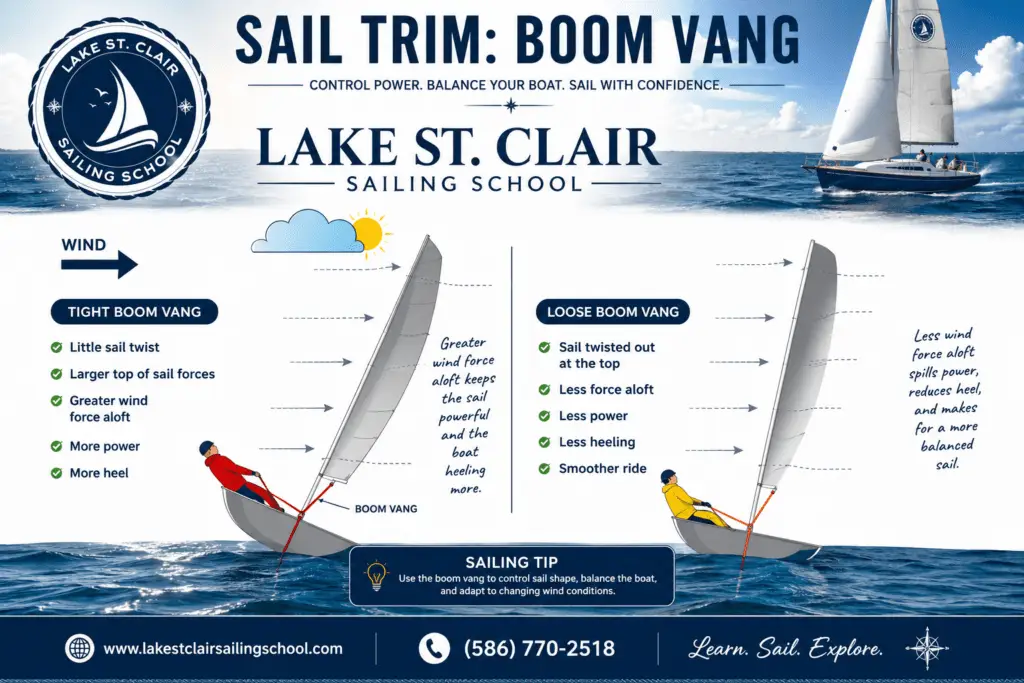
On the left side, the boom vang is tightened. A tight boom vang pulls the boom downward, reducing sail twist and keeping more of the sail exposed to stronger wind higher aloft. This increases power and can cause the boat to heel more aggressively. Tight vang settings are commonly used when sailors want maximum sail efficiency and speed. On the right side, the boom vang is loosened. A loose boom vang allows the top of the sail to twist off and spill excess wind. This reduces pressure on the upper part of the sail, decreases heeling, and gives the boat a more balanced and comfortable ride in stronger winds. The diagram highlights an…

Crew Moves to Leeward When the wind is light, moving the crew to the leeward side helps the sailboat sail more efficiently by creating a small amount of heel (lean) toward the leeward side. Here’s why: 1. Improves Sail Shape A slight heel helps the sails form a better aerodynamic shape, allowing them to generate more lift in light air. 2. Reduces Wetted Surface Most sailboats are designed to sail best with a small amount of heel. Leaning the boat slightly can reduce the amount of hull dragging through the water, decreasing resistance. 3. Helps the Sails Fill In very light wind, sails can collapse or flap. A gentle heel encourages the sails…
ASA 103 Coastal CruisingLeave your marina and explore cruising on a larger boat ASA 103 Coastal Cruising prepares sailors for more advanced and independent cruising aboard larger boats, learning to navigate in coastal waters, and manage a variety of onboard systems. From anchoring and docking to planning multi-day trips, ASA 103 empowers you to explore further, experience new destinations, and enjoy the freedom that comes with coastal cruising. The adventure is yours—set sail and embrace the coastal lifestyle! Charts & Navigation Sounding: The depth of the water as measured from the chart datum (usually Mean Lower Low Water). Units of Sounding: Feet, fathoms, or meters. Fathom Conversion: 1 fathom = 6 feet. Latitude:…
N ASA 103 Quiz Basic Coastal Cruising · 20 Questions Question 1 of 20 0% Navigation · Rules of the Road Score: 0 / 20 Next → 0% score 0Correct 0Incorrect ↺ Retake quiz American Sailing Association · Standard 103
Video-Style Animation Wind is hitting the boat from astern. The sailboat gybes from a port tack to a starboard tack while the boom swings across. Teaching Focus Watch the stern pass through the wind first, then watch the boom cross from port side to starboard side. Wind From Astern Start: Port Tack Finish: Starboard Tack Boom on port side Step 1 The boat begins on port tack with the wind coming from astern and the boom carried out on the port side. Sailing Demo Gybe From Port Tack To Starboard Tack This animation is designed like a simple teaching video. It emphasizes three ideas: the wind is from behind the…