Skip to content
U.S. Navigation Rules,
made easier to learn.
A practical, interactive guide to Rules 1–38: collision avoidance, right-of-way responsibilities, navigation lights, sound signals, and the differences between Inland and International Rules.
Educational summary · Not a substitute for the official USCG Navigation Rules
Three principles every skipper should know.
These principles apply to sailboats and powerboats, day and night.
Keep a proper lookout
Use sight, hearing, and every appropriate means to understand what is happening around your vessel.
Travel safely. Assess risk.
Maintain safe speed, monitor approaching traffic, and treat doubt about collision risk seriously.
Act early and clearly
Make positive, timely maneuvers and verify that you are passing at a safe distance.
Who must keep clear?
Select a common encounter. The applicable rule and practical answer appear below.
When two sailing vessels approach on opposite tacks with a collision risk, the vessel with wind on its port side keeps out of the way of the vessel on starboard tack.
Simplified encounters. Always assess collision risk and account for restricted visibility, narrow channels, traffic schemes, and other relevant rules.
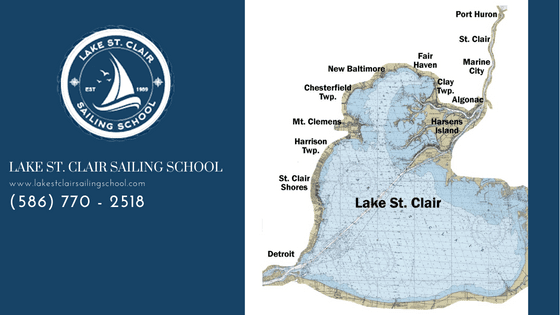
On Lake St. Clair: know the Inland Rules.
The U.S. side of Lake St. Clair and the Great Lakes is generally governed by U.S. Inland Navigation Rules. Other waters can fall under International Rules across the relevant demarcation lines.
Sound signals mean different things
Under International Rules, one short blast announces alteration to starboard; under Inland Rules it expresses an intent to leave the other vessel on your port side, with further agreement requirements as applicable.
Great Lakes special provisions
Some provisions concerning following currents and crossing traffic differ from the International text. Consult the full Inland Rules.
Constrained by draft
This vessel classification is addressed by the International Rules. Inland Rule 28 is reserved.
All 38 navigation rules.
Choose a category and open a rule to read its short explanation. The full official text contains exceptions and important operating details.
Part A · General · Rules 1–3
Rule 1Application
Rule 2Responsibility
Rule 3General Definitions
Part B · Any visibility · Rules 4–10
Rule 4Application
Rule 5Look-out
Rule 6Safe Speed
Rule 7Risk of Collision
Rule 8Action to Avoid Collision
Rule 9Narrow Channels
Rule 10Traffic Separation Schemes
Part B · In sight · Rules 11–18
Rule 11Application
Rule 12Sailing Vessels
Rule 13Overtaking
Rule 14Head-on Situation
Rule 15Crossing Situation
Rule 16Action by Give-way Vessel
Rule 17Action by Stand-on Vessel
Rule 18Responsibilities Between Vessels
Part B · Restricted visibility · Rule 19
Rule 19Conduct in Restricted Visibility
Part C · Lights & shapes · Rules 20–31
Rule 20Application
Rule 21Definitions
Rule 22Visibility of Lights
Rule 23Power-driven Vessels Underway
Rule 24Towing and Pushing
Rule 25Sailing Vessels and Vessels Under Oars
Rule 26Fishing Vessels
Rule 27Not Under Command / Restricted Ability to Maneuver
Rule 28Vessels Constrained by Draft
Rule 29Pilot Vessels
Rule 30Anchored Vessels and Vessels Aground
Rule 31Seaplanes
Part D · Sound & light signals · Rules 32–37
Rule 32Definitions
Rule 33Equipment for Sound Signals
Rule 34Maneuvering and Warning Signals
Rule 35Sound Signals in Restricted Visibility
Rule 36Signals to Attract Attention
Rule 37Distress Signals
Part E · Exemptions · Rule 38
Rule 38Exemptions
Also consult Annexes I–V (including the Inland-only pilot provisions), and Part F, Rules 39–41, where applicable. This page intentionally follows the scope of the original study guide: Rules 1–38.
Test your seamanship.
Two sailboats, different tacks. Who gives way?
Two powerboats cross. You see the other to starboard. Who gives way?
You are overtaking another vessel. Who keeps clear?
Frequently asked questions.
Does a sailboat always have priority over a powerboat?
What is the difference between give-way and stand-on?
Are the rules different in fog?
Where can I find the full official text?
Learn to sail with confidence.
Build hands-on seamanship skills with US Coast Guard licensed captains and American Sailing certified instructors at Lake St. Clair Sailing School in Harrison Township, Michigan.
Lambrecht Marina · 31300 North River Road · Harrison Township, MI 48045 · Slip A3