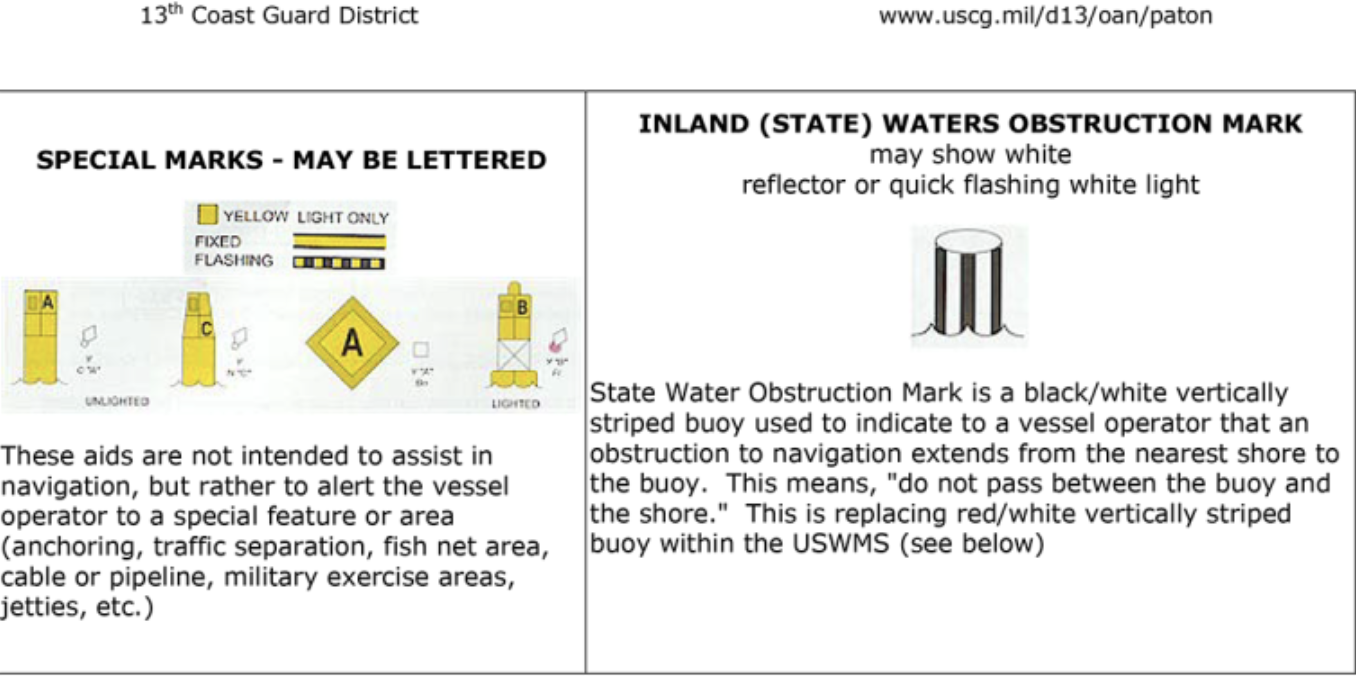
Special Marks

Special Marks for Navigation Aids: Understanding Yellow Marks on the Water When navigating coastal and inland waterways, boaters rely on a standardized system of navigation aids to ensure safe passage. One important but often misunderstood part of this system is yellow special marks. Unlike red and green lateral markers that guide vessels through channels, yellow marks serve a different purpose: they highlight special areas or features on the water. What Are Yellow Special Marks? Yellow marks, officially known as Special Marks, are part of the International Association of Marine Aids to Navigation and Lighthouse Authorities (IALA) buoyage system. Their primary role is to draw attention to a specific area, condition, or activity, rather…
Comments Off on Special Marks
Read more about the article Special Marks
special marks - navigations aids

Light List

LIGHT LIST (2021 ANNUAL PUBLICATION) https://www.navcen.uscg.gov/?pageName=lightLists

Comments Off on Light List

Regulatory Marks

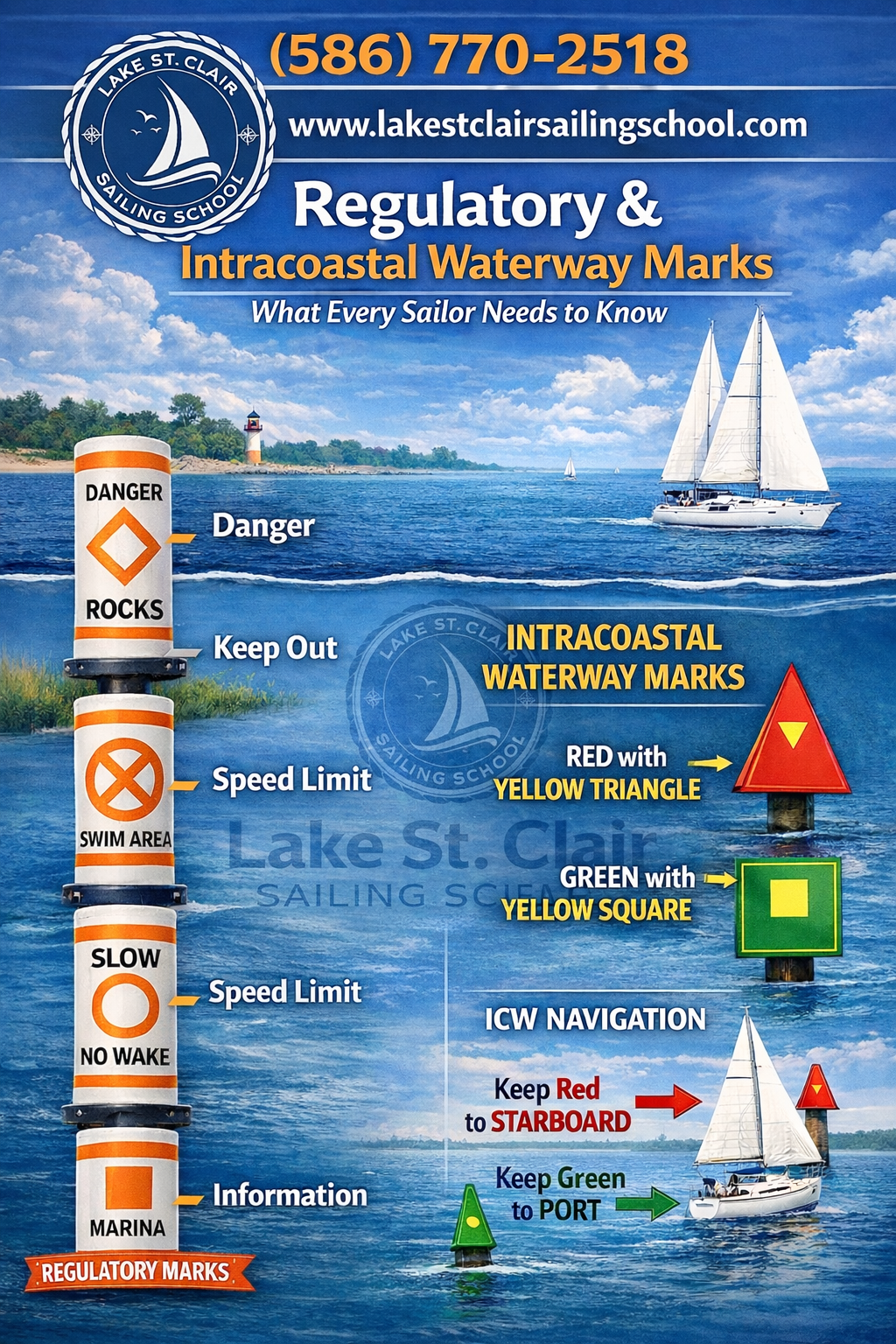
Regulatory Marks: What Every Sailor on Lake St. Clair Needs to Know Regulatory marks are essential navigational aids designed to help sailors safely navigate oceans, seas, and inland waterways such as Lake St. Clair. These marks provide critical information about restrictions, hazards, and rules that boaters must follow to ensure safe and responsible navigation. What Are Regulatory Marks? Regulatory marks are white “can” buoys marked with orange symbols and, in many cases, black lettering. Unlike lateral markers that guide direction, regulatory marks are intended to warn, inform, or regulate boater behavior. When approaching one of these buoys, sailors should slow down, read the message carefully, and comply with the instructions shown. Common Types…

Comments Off on Regulatory Marks
Read more about the article Regulatory Marks
navigational aids

Required Safety Equipment

Life JacketsA properly fitting and serviceable jacket for every person on board. Fire ExtinguisherIt must be a Coast Guard-approved B1 model. ThrowableBoats over 16 feet must carry a throwable device. Signaling DeviceA bell, whistle, or horn to warn other boaters. Visual Distress SignalPhoto of a hand flare For boats under 16 feet, this is required only at night; for boats over 16 feet, this is required both day and night. Different rules apply on small bodies of water, but it’s always wise to carry them.

Comments Off on Required Safety Equipment
Read more about the article Required Safety Equipment
Required Safety Equipment

Aground Vessels: How to Recognize the Signals on Lake St. Clair

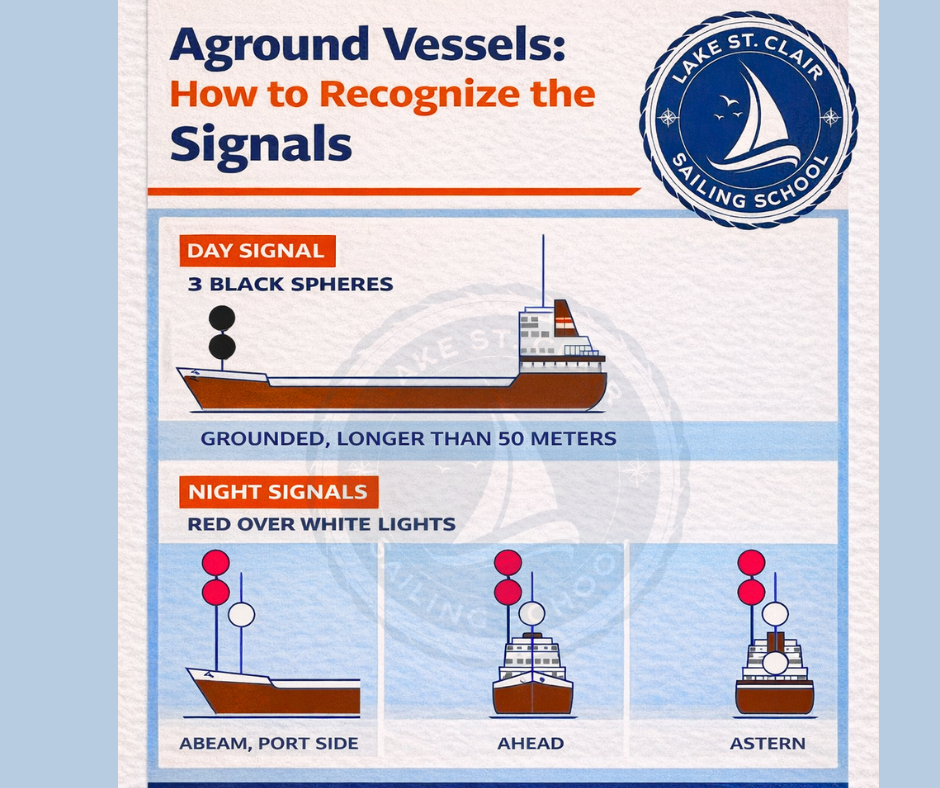
Aground Vessels: How to Recognize the Signals on Lake St. Clair When sailing on Lake St. Clair, understanding navigation signals is essential for safety and confident seamanship. One important situation every sailor should recognize is an aground vessel. The attached image illustrates the correct day shapes and night lights displayed by large vessels that are aground, and knowing what these signals mean can help you avoid danger on the water. What Does “Aground” Mean? A vessel is considered aground when it is stuck on the bottom and unable to maneuver as intended. This may happen in shallow areas, channels, or near shoals. On Lake St. Clair, where water depths can change quickly, recognizing…

Comments Off on Aground Vessels: How to Recognize the Signals on Lake St. Clair
Read more about the article Aground Vessels: How to Recognize the Signals on Lake St. Clair
aground

Anchoring

Anchoring Lights (Colreg) Colreg rules. Lights during anchoring. Vessel of less than 50 m in length at anchor from sunset to sunrise and from sunrise to sunset in restricted visibility Anchored vessel, longer than 50 mDay sign (1 black sphere)Abeam, port sideAheadAsternAnchored vessel, shorter than 50 mDay sign (1 black sphere)Abeam, port sideAheadAsternAnchored sailing boatDay sign (1 black sphere)Abeam, port sideAheadAstern

Comments Off on Anchoring

Sailing And Motoring

Sailing and Motoring A vessel proceeding under sail which has her engine running shall exhibit forward where it can best be seen a conical shape, apex downwards.She shall exibit lights according to a power-driven vessel. Sailing and motoringDay signAbeam, port sideAheadAstern

Comments Off on Sailing And Motoring

Power-Driven Vessel Underway

Power-driven vessel underway A power-driven vessel underway shall exhibit: a masthead light forward;a second masthead light abaft of and higher than the forward one; except that a vessel of less than 50 metres in length shall not be obliged to exhibit such light but may do so;sidelights;a sternlight. Power driven vessel underway, longer than 50 mAbeam, port sideAheadAsternPower driven vessel underway, shorter than 50 mAbeam, port sideAheadAstern

Comments Off on Power-Driven Vessel Underway

End of content

No more pages to load