Skip to content
Regulatory Marks: What Every Sailor on Lake St. Clair Needs to Know
Regulatory marks are essential navigational aids designed to help sailors safely navigate oceans, seas, and inland waterways such as Lake St. Clair. These marks provide critical information about restrictions, hazards, and rules that boaters must follow to ensure safe and responsible navigation.
What Are Regulatory Marks?
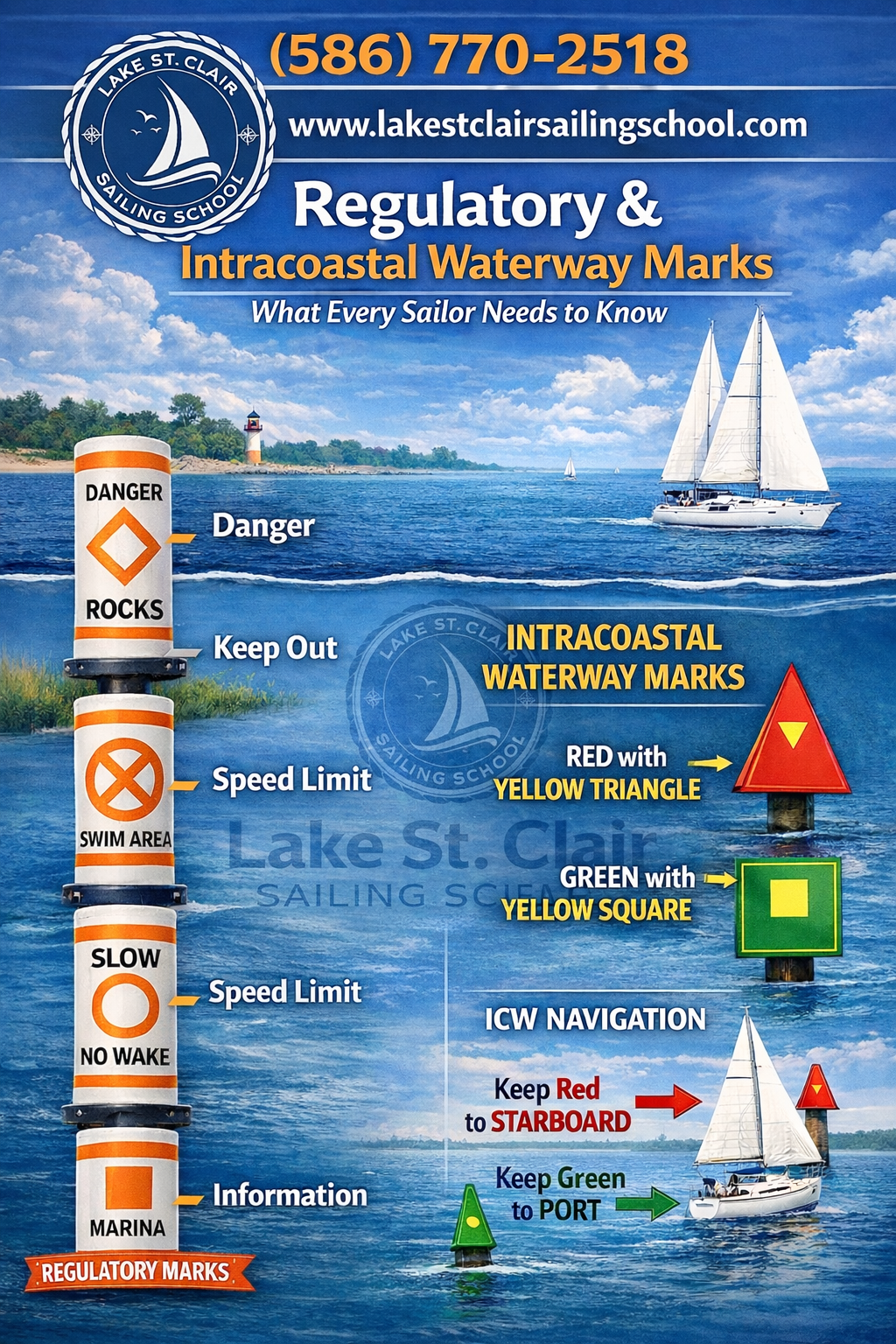
Regulatory marks are white “can” buoys marked with orange symbols and, in many cases, black lettering. Unlike lateral markers that guide direction, regulatory marks are intended to warn, inform, or regulate boater behavior. When approaching one of these buoys, sailors should slow down, read the message carefully, and comply with the instructions shown.
Common Types of Regulatory Marks
Regulatory marks may display different orange symbols, each with a specific meaning:
- Danger Marks
Identified by an orange diamond, these warn of hazards such as rocks, shallow water, submerged objects, or other dangers. Some include additional text explaining the risk. - Exclusion or Keep-Out Marks
Shown as an orange diamond with a cross, these indicate areas vessels must not enter, such as swimming zones, dams, or environmentally protected areas. - Speed Control Marks
These inform sailors of speed limits, including idle-speed or no-wake zones. Observing these restrictions helps protect shorelines, docks, swimmers, and other vessels. - Information Marks
Marked with an orange square, these provide general information such as directions, distances, or local boating guidance.
Intracoastal Waterway Marks
When sailing in coastal regions or traveling along the Intracoastal Waterway (ICW), sailors will encounter a special set of navigational aids designed to mark the safest route through bays, rivers, and canals.
Intracoastal Waterway marks use yellow symbols in combination with standard red and green lateral markers:
- Yellow triangles are placed on red markers
- Yellow squares are placed on green markers
The yellow symbols indicate the preferred channel of the Intracoastal Waterway, helping sailors stay within the protected route. When following the ICW, boaters should keep red markers to starboard and green markers to port when traveling in the conventional direction, while also paying attention to the yellow shapes to remain on the correct waterway.
Understanding Intracoastal Waterway marks is especially important for sailors planning coastal passages, long-distance cruising, or charter trips, as they help prevent groundings and guide vessels through narrow or shifting channels.
Why These Marks Matter on Lake St. Clair and Beyond
Lake St. Clair is a busy waterway shared by sailors, powerboats, anglers, and paddlers. Regulatory marks help maintain order and safety by clearly identifying hazards and enforcing boating rules. As sailors expand their experience to coastal and intracoastal waters, understanding both regulatory marks and Intracoastal Waterway marks becomes an essential skill for safe navigation anywhere in the world.
Learn Navigation Skills with Lake St. Clair Sailing School
At Lake St. Clair Sailing School, we teach practical navigation skills and real-world safety knowledge, including regulatory marks and Intracoastal Waterway navigation. Whether you are a beginner or advancing toward coastal cruising, mastering these aids to navigation is a key step toward confident seamanship.
📞 Call (586) 770-2518
🌐 Visit www.lakestclairsailingschool.com
Learn to sail safely, confidently, and responsibly on Lake St. Clair and beyond.